A note on sources. Biblical quotations follow the New Revised Standard Version (NRSV), copyright © 1989 National Council of the Churches of Christ in the USA. Quotations from the Nag Hammadi texts follow the translations collected in The Nag Hammadi Library in English, ed. James M. Robinson (Leiden: Brill; San Francisco: HarperCollins): The Apocryphon of John (NHC II,1) trans. Frederik Wisse. The spelling “Yaldabaoth” is used throughout for consistency; Wisse’s translation renders the same name “Yaltabaoth.”
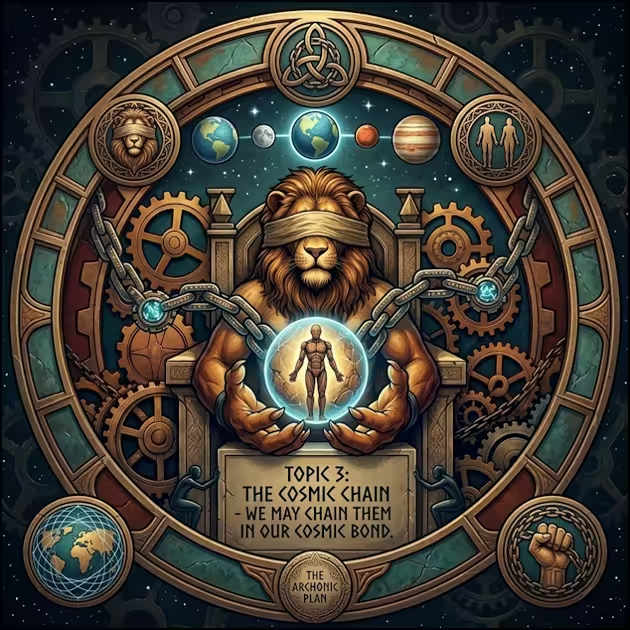
If the first mark of Yaldabaoth is blindness, and the second is domination, the third is reduction. The archontic imagination drags spirit downward until human beings can no longer imagine themselves as anything more than bodies to be managed, appetites to be manipulated, and labor to be extracted. In Gnostic myth, the rulers do not merely deceive the mind or police the social order. They bind the human being to matter in such a way that forgetfulness begins to feel natural. The prison becomes ordinary. The soul begins to mistake captivity for identity.
This is why the material imagery in The Apocryphon of John is so severe. After the archons fashion Adam, the text says they bring him into “the shadow of death” and clothe him in “the tomb of the newly-formed body,” calling it also “the bond of forgetfulness.”[^1] Later, the revealer speaks even more bluntly: “the body is that prison.”[^2] The point is not a simplistic hatred of embodiment. The text is not saying that matter, as such, is evil in some abstract metaphysical sense. It is saying that the rulers convert embodiment into confinement. Flesh becomes the medium through which ignorance, desire, shame, and mortality are organized into a system that keeps human beings from remembering their origin. Materiality under the archons is never neutral. It is administered.
That distinction matters, because otherwise the argument collapses into caricature. The problem is not that bodies exist, or that people need food, shelter, sex, money, and material forms of life. The problem is what happens when a religious system treats those goods either as proof of divine approval or as objects of obsessive surveillance. On one side lies sacralized wealth. On the other lies sacralized control. Both reduce the human person to something that can be measured from the outside. Both relocate spiritual judgment into the realm of possession, compliance, and visible purity. And both are ways of mistaking the physical realm for the clearest revelation of God’s favor.
This is where the comparison to modern right-wing Evangelicalism becomes especially uncomfortable, because the contradiction is so open. The same subcultures that preach distrust of “worldliness” often remain fascinated by wealth, platform, celebrity, conquest, and conspicuous success. The Prosperity Gospel is simply the crudest version of that logic, declaring outright that material abundance is evidence of divine blessing and that poverty signals spiritual defect, insufficient faith, or hidden failure. But the same imagination extends far beyond formally prosperity-preaching churches. Whenever numerical growth, institutional scale, real-estate expansion, donor prestige, media reach, and entrepreneurial charisma are treated as obvious signs of God’s favor, material magnitude has already begun to function theologically.
Jesus names the danger with unusual clarity in Matthew: “No one can serve two masters; for a slave will either hate the one and love the other, or be devoted to the one and despise the other. You cannot serve God and wealth” (Matthew 6:24, NRSV).[^3] The force of the warning lies precisely in the fact that wealth behaves like a rival sovereignty. It does not remain a tool. It asks for loyalty. It restructures desire. It trains the eye to read security, prestige, and immunity as forms of salvation. That is why any movement that routinely confuses material scale with spiritual legitimacy should be approached with suspicion, no matter how often it speaks the language of revival.
But the archontic reduction of the human being does not stop with wealth. If prosperity theology makes a sacrament out of accumulation, purity culture makes a sacrament out of bodily regulation. Here again the issue is not discipline itself. Traditions can ask difficult things of bodies for meaningful reasons. Fasting, chastity, sobriety, and restraint can all be intelligible forms of spiritual practice. The pathology begins when the body becomes the preferred site on which authority proves itself. In that setting, sexuality is not treated as one dimension of ethical life among others, but as the central theater in which submission, hierarchy, gender order, and communal belonging are staged.
This is why the politics of bodily control has such gravitational pull in the religious right. Reproductive control, anti-queer moral panic, the fixation on women’s dress and comportment, the rhetoric of contamination, the constant monitoring of desire, and the insistence that gender hierarchy reflects divine design all belong to the same pattern. The body becomes legible to power. It must be named, sorted, disciplined, and contained. A community can ignore greed, cruelty, and exploitation for years while erupting in panic over sexuality, because sexuality offers what more difficult moral questions do not: a visible surface on which control can be dramatized.
The Gnostic material is illuminating here because it repeatedly links the archons to bodily fear, confusion, and manipulated desire. In Wisse’s translation, the counterfeit body is explicitly tied to “ignorance of darkness and desire,” while the rulers bring human beings under “the bond of forgetfulness.”[^1] Later, the chief archon plants sexual desire into the human pair and uses reproduction to extend his counterfeit order through history.[^4] Whether or not one accepts the underlying cosmology, the symbolic pattern is clear enough: domination deepens when power can recruit shame, appetite, and fear from inside the self. External chains are no longer enough. The person must learn to police the person.
That is what gives bodily surveillance its particular force in authoritarian religion. It is efficient. A regime that can persuade people that their own flesh is suspect, that their own desires are presumptively dangerous, and that institutional authority alone can tell them whether they are clean or defiled has created a remarkably durable form of obedience. The system does not need to coerce at every moment because it has already entered the conscience as a monitoring presence.
This is also why shame is such an important category here. Shame is not identical with guilt. Guilt says, “I have done wrong.” Shame says, “I am wrong in my exposed condition.” A tradition organized around repentance can use guilt to restore truth and relationship. A system organized around bodily domination uses shame to make exposure itself unbearable. Once that happens, authority no longer needs to teach wisdom. It only needs to manage concealment. Whole moral worlds can then be built around secrecy, image maintenance, and ritualized self-denunciation, while the structures generating the shame remain untouched.
A fair objection at this point would be that the essay is in danger of flattening all Evangelical concern with sex, family, or bodily ethics into authoritarian pathology. That would be too crude. The diagnosis is not triggered merely because a community teaches a sexual ethic, opposes certain practices, or believes that bodies matter morally. It applies when bodily concern becomes selective, obsessive, and asymmetrical: when the body is scrutinized chiefly as a field of hierarchy and contamination; when wealth and domination receive theological indulgence while sexuality receives relentless surveillance; when external markers of purity count for more than mercy, truthfulness, or justice; and when fear of disorder becomes more animating than love of holiness. Where accountability is mutual, where shame is not the principal instrument, and where bodily ethics are held within a larger horizon of compassion and truth, the archontic diagnosis does not automatically follow.
Still, the pattern is hard to miss once named. Prosperity rhetoric and purity rhetoric appear, on the surface, to point in opposite directions. One celebrates abundance; the other celebrates restriction. One blesses possession; the other disciplines desire. Yet both rely on the same reduction. They treat the visible, measurable, externally legible body as the privileged site where God’s favor, displeasure, or order can be read off with confidence. They turn matter into revelation. In one case the proof is success; in the other it is compliance. In both cases the inner work of transformation is displaced by surfaces that institutions can manage.
The Apocryphon presses the point even further when it describes how the rulers led people astray through gold, silver, and “all kinds of things,” and how the world became enslaved through deception, distraction, and forgetfulness.[^5] That is an important reminder that material control works not only through prohibition but through seduction. The prison of the body is not maintained by fear alone. It is also maintained by appetite, aspiration, and the fantasy that one more acquisition, one more achievement, one more act of conformity will finally secure peace. The rulers do not merely threaten. They entice.
That may be the most useful way to frame Point 3. The archontic order knows how to work both sides of material life at once. It can sell wealth as blessing while selling shame as holiness. It can promise success to the powerful and purity to the compliant. It can preach against the flesh while quietly relying on fleshly fear, fleshly aspiration, and fleshly display to keep the system intact. The result is a religion trapped in the very realm it claims to transcend.
The Christian objection to all of this is not that matter is unreal, or that bodies are disposable, or that economics and sexuality do not matter. It is that the gospel cannot be reduced to the management of surfaces. If the good news concerns liberation, reconciliation, and the renewal of the person in truth, then no amount of wealth can certify it and no apparatus of bodily policing can produce it. A church may become rich, numerically large, sexually anxious, politically controlling, and morally theatrical all at once while remaining spiritually starved.
That is why the comparison to Yaldabaoth retains its force here. The Demiurge is the ruler of the lower order precisely because he mistakes control over matter for mastery over reality. Modern religious systems repeat that mistake whenever they equate divine favor with possession, equate holiness with surveillance, or treat the body as the primary object through which authority must display itself. The sign is not that they care about material life, but that they cannot imagine spiritual life except in materialized terms of success, purity, and control. At that point, wealth and bodily discipline cease to be subordinate goods and become idols of administration. The prison is no longer merely occupied. It is being praised.
[^1]: The Apocryphon of John / The Secret Book of John, NHC II,1, trans. Frederik Wisse, in The Nag Hammadi Library in English, ed. James M. Robinson; Gnostic Society Library, http://www.gnosis.org/naghamm/apocjn.html. The rulers bring Adam into “the shadow of death” and clothe him in “the tomb of the newly-formed body,” “the bond of forgetfulness,” tied to “ignorance of darkness and desire.”
[^2]: Apocryphon of John, NHC II,1, Wisse trans.; Gnostic Society Library, http://www.gnosis.org/naghamm/apocjn.html. In the Pronoia hymn, the revealer enters “their prison,” adding, “the body is that prison.”
[^3]: Matthew 6:24, New Revised Standard Version, oremus Bible Browser, https://bible.oremus.org/?passage=Matthew%206:24&version=nrsv.
[^4]: Apocryphon of John, NHC II,1, Wisse trans.; Gnostic Society Library, http://www.gnosis.org/naghamm/apocjn.html. The chief archon “planted sexual desire” and produced bodily copies through intercourse, extending the counterfeit order.
[^5]: Apocryphon of John, NHC II,1, Wisse trans.; Gnostic Society Library, http://www.gnosis.org/naghamm/apocjn.html. The rulers “brought gold and silver and a gift and copper and iron and metal and all kinds of things” and “the whole creation became enslaved forever” through deception and forgetfulness.