A note on sources. Biblical quotations follow the New Revised Standard Version (NRSV), copyright © 1989 National Council of the Churches of Christ in the USA. Quotations from the Nag Hammadi texts follow the translations collected in The Nag Hammadi Library in English, ed. James M. Robinson (Leiden: Brill; San Francisco: HarperCollins): On the Origin of the World (NHC II,5) trans. Hans-Gebhard Bethge and Bentley Layton. The spelling “Yaldabaoth” is used throughout for consistency, though some editions render the name “Yaltabaoth.”
If the first mark of Yaldabaoth is blindness, the second is administration. A false god does not remain an idea for long. He requires structures, ranks, prohibitions, punishments, and managed thresholds. He needs officials. He needs mechanisms. He needs a world in which fear can be routinized. In Gnostic myth, the Demiurge does not simply misunderstand reality; he governs through the misunderstanding. His ignorance becomes a system.
That is why the language of “rulers” matters so much in these texts. In On the Origin of the World, the authorities do not merely create a human being out of curiosity or delight. They act strategically. After the appearance of the luminous human, they fear their own displacement and say, “Come let us create a man out of earth, according to the image of our body and according to the likeness of this being, to serve us.”[^1] The point is not only fabrication but subordination. The modelled form is meant to secure obedience. Elsewhere in the same text, the authorities surround the tree of life with “great fearful things” so that no earthly being may enter.[^2] Their rule is built out of boundary, exclusion, and threatened penalty. The archontic order is legal before it is ethical. It does not guide souls into maturity; it keeps them in a managed dependency.
This distinction matters, because any serious argument here has to avoid the lazy conclusion that law itself is the problem. It is not. Every community has norms. Every tradition has disciplines, judgments, and boundaries. The real question is what those structures are for. Do they cultivate truth, repentance, mercy, and freedom? Or do they protect the institution’s monopoly on legitimacy? Law becomes archontic when it ceases to be a servant of life and becomes a technology of control. What marks the difference is not the mere presence of commandments, but whether the system permits growth, correction, and inward transformation, or whether it reduces religion to surveillance backed by fear.
That is where the comparison to modern right-wing Evangelicalism becomes most acute. Much of the contemporary religious right speaks as though the deepest crisis facing Christianity were not greed, cruelty, militarism, indifference to the poor, or spiritual deadness, but the loss of social dominance. The desired remedy is therefore not renewal but control: control of school boards, libraries, courts, curricula, sexuality, reproduction, and public language itself. In such a framework, theology becomes managerial. The church’s energy is drawn toward enforcement rather than illumination, toward policing rather than transformation, toward victory rather than sanctity. Christian Nationalism is the most obvious form of this logic, because it imagines political power not as one limited arena of prudential action but as the privileged instrument through which a supposedly Christian order must be imposed on everyone else.
That last phrase matters: imposed. One way to test whether a movement has entered an archontic mode is to ask how often it imagines spiritual truth as something that can be secured externally. Can righteousness be produced by statute? Can holiness be delivered by court decision? Can fear of punishment substitute for awakened conscience? A legal order may restrain harm, which is not nothing. But it cannot itself create the inner transformation that Christianity claims to seek. When a religious movement repeatedly behaves as though it can save a culture by coercing it, the movement has already shifted from discipleship to domination.
The Gnostic parallel helps clarify why. The rulers in these texts are forever trying to fence off access to life, knowledge, and ascent. They construct enclosures. They frighten. They issue commands whose deepest function is not to heal but to keep beings in place. In that sense, law under the archons is theatrical. It dramatizes power. It teaches subordinates where they stand. It makes hierarchy feel metaphysically necessary.
The New Testament knows this danger well. Jesus’ rebuke in Luke is not aimed at law as such, but at those who weaponize religious authority: “Woe to you lawyers! For you have taken away the key of knowledge; you did not enter yourselves, and you hindered those who were entering” (Luke 11:52, NRSV).[^3] This is one of the sharpest lines in the Gospels because it names a specifically institutional sin. The problem is not merely private hypocrisy. The problem is that gatekeepers have turned stewardship into obstruction. They do not simply fail to enter; they organize the failure of others.
That line provides a more precise way to describe the pathology under discussion. The issue is not moral seriousness. It is not even strictness. Traditions can be demanding without becoming archontic. The issue is a pattern in which religious elites claim unique custody over truth while using law, shame, and fear to narrow access to it. They remove the key of knowledge and then call the resulting confinement faithfulness.
This is why legalism, in this context, is not best understood as “caring too much about rules.” That description is too shallow. Legalism is what happens when rules become detached from their stated end and are instead treated as signs of tribal loyalty and instruments of rank. At that point, obedience matters less because it forms character than because it displays submission. The community becomes expert at evaluating infractions while growing strangely numb to the deeper moral failures that its own structures sustain. Harshness toward outsiders and protectiveness toward insiders begin to coexist without embarrassment. The law appears strong precisely where justice is weak.
A critic could reasonably ask whether this argument overstates the case by collapsing all public moral action into domination. It does not. Churches and religious citizens will always make moral claims in public, and they should. The test is whether they imagine coercive power as primary, and whether they remain accountable to the same standards they impose. A movement that fights for the vulnerable, submits itself to scrutiny, accepts pluralism as a civic fact, and treats the state as limited is not yet archontic simply because it cares about law. The diagnosis applies when political and religious authority fuse into a system that treats dissent as contamination and imagines social control as the clearest sign of divine order.
Seen in that light, the obsession with judgment becomes easier to understand. Judgment, in the healthy theological sense, is the unveiling of truth. It is what exposes falsehood, calls evil by its name, and opens the possibility of repentance. But in the archontic sense, judgment becomes a mood, then a weapon, then an identity. A movement learns to live by denunciation. The constant need to identify enemies, classify threats, and punish deviation gives the community its emotional coherence. This is why so much right-wing Evangelical politics feels saturated with accusation. It is not only strategic. It is liturgical. Condemnation becomes a ritual through which the group reassures itself that it still stands on the side of order.
Once that happens, domination no longer looks like domination from within the system. It looks like responsibility. It looks like courage. It looks like being “faithful in a hostile age.” That is the final trick of the archons: to baptize the appetite for power as moral necessity. The rulers in the Gnostic texts never describe themselves as jailers. They present themselves as custodians of order. Modern religious authoritarianism does much the same. It names control protection, names exclusion discernment, names domination righteousness.
The deepest Christian objection to this posture is not merely political but theological. If Christ’s work is inward, liberating, and transformative, then any system that treats external force as spiritually decisive has misunderstood the terrain on which the gospel moves. It may win compliance. It may secure institutions. It may produce silence. But silence is not peace, and conformity is not conversion. A church can build an apparatus strong enough to punish dissent and still remain incapable of producing love, mercy, wisdom, or holiness.
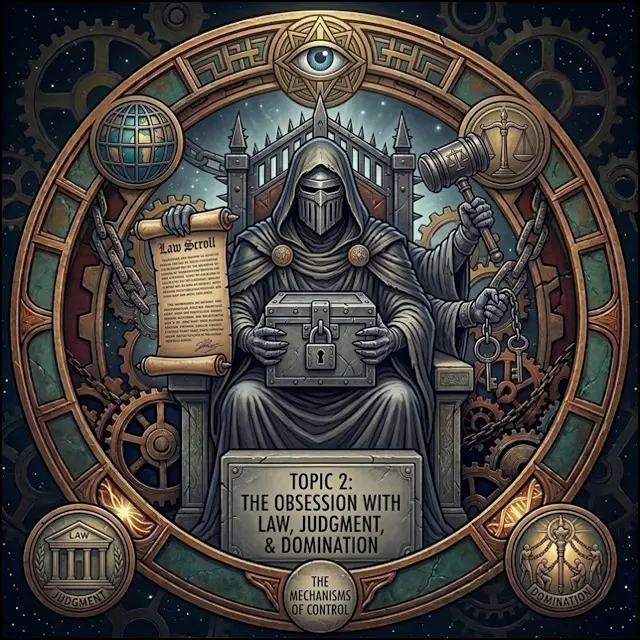
That is why Point 2 belongs immediately after the question of blindness. Once a system becomes incapable of recognizing truth beyond itself, it must compensate with enforcement. Ignorance seeks police. Fragile authority seeks spectacle. A counterfeit god who cannot persuade must rule. And when a religious movement becomes preoccupied with law, judgment, and domination in precisely that way, the comparison to Yaldabaoth ceases to be ornamental. It becomes diagnostic. The sign is not that a people have commandments, but that they have come to love the machinery more than the light.
[^1]: On the Origin of the World (“The Untitled Text”), NHC II,5, trans. Hans-Gebhard Bethge and Bentley Layton, in The Nag Hammadi Library in English, ed. James M. Robinson; Gnostic Society Library, http://www.gnosis.org/naghamm/origin.html. The authorities say, “Come let us create a man out of earth, according to the image of our body and according to the likeness of this being, to serve us.”
[^2]: On the Origin of the World, NHC II,5, Bethge and Layton trans.; Gnostic Society Library, http://www.gnosis.org/naghamm/origin.html. After expelling Adam, the rulers surround the tree of life with “great fearful things” and a flaming sword so that no earthly being may enter.
[^3]: Luke 11:52, New Revised Standard Version, oremus Bible Browser, https://bible.oremus.org/?passage=Luke%2011:52&version=nrsv