A note on sources. Biblical quotations follow the New Revised Standard Version (NRSV), copyright © 1989 National Council of the Churches of Christ in the USA. Quotations from the Nag Hammadi texts follow the translations collected in The Nag Hammadi Library in English, ed. James M. Robinson (Leiden: Brill; San Francisco: HarperCollins): The Apocryphon of John (NHC II,1) trans. Frederik Wisse, and The Hypostasis of the Archons (NHC II,4) trans. Bentley Layton. The spelling “Yaldabaoth” is used throughout for consistency; Wisse’s translation renders the same name “Yaltabaoth.”
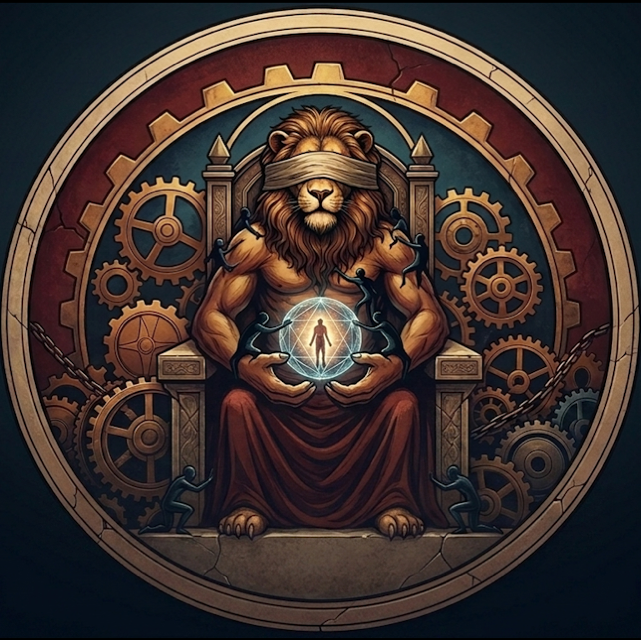
The first mark of Yaldabaoth is not cruelty, though cruelty follows quickly. It is epistemic arrogance: the refusal to recognize any reality beyond the boundary of his own power. In the Gnostic imagination, the Demiurge is not simply a false god because he creates a material world. He is false because he mistakes his limited domain for the whole of reality. He looks at the small cosmos he governs, cannot see beyond it, and turns that blindness into a doctrine. His ignorance becomes sovereignty.
This is why the language surrounding Yaldabaoth is so sharp. In The Apocryphon of John, the chief ruler is given three names: Yaldabaoth, Saklas, and Samael. The text explains that he is impious in his arrogance, declaring, “I am God and there is no other God beside me,” precisely because he is ignorant of “the place from which he had come.”[^1] The Hypostasis of the Archons makes the diagnosis even more direct: “Their chief is blind,” and because of “his power and his ignorance and his arrogance,” he announces, “It is I who am God; there is none apart from me.”[^2] The point is not merely that Yaldabaoth makes an incorrect theological claim. The point is that his claim depends on a closed horizon. He cannot imagine what he cannot see, and then he makes that incapacity the law of the universe.
That is the Gnostic shape of the closed system: ignorance first becomes a limit, then a virtue, then an instrument of rule. The ruler does not say, “I do not know.” He says, “There is nothing more to know.” He does not encounter mystery with humility. He meets it with prohibition. Any voice from beyond the enclosure becomes a threat, because even the possibility of a higher truth exposes the fragility of his authority.
Before pressing the comparison to modern religion, it is worth drawing the distinction on which the whole argument turns, because an obvious objection arises immediately: does not every conviction, including this essay’s, operate inside some boundary? It does. The difference is not between people who have limits and people who do not. It is between two postures toward those limits. Discernment tests, listens, interprets, and remains accountable to reality; it can be moved by evidence and can name its own errors. Enclosure begins with the verdict and arranges the evidence afterward; nothing is permitted to count against it. A closed system is not one that holds strong beliefs. It is one that has made itself incapable of being wrong.
This is where the comparison to modern right-wing Evangelicalism becomes most revealing. At its best, Christian faith has never required contempt for knowledge, and this is a claim grounded not in sentiment but in the tradition’s own texts. Job protests against God and is vindicated over his more orthodox friends. The prophets argue and God invites the argument: “Come now, let us argue it out” (Isaiah 1:18, NRSV).[^3] Jesus disputes openly with scribes and lawyers; Paul reasons in synagogues and debates philosophers at the Areopagus. The tradition wrestles with God rather than sealing God inside a slogan. But in many right-wing Evangelical settings, faith is redefined as the defense of a closed interpretive system against outside knowledge: mainstream science, historical-critical scholarship, comparative religion, and the testimony of people harmed by the system itself. The problem is not conviction. The problem is training believers to treat inquiry as rebellion and curiosity as contamination.
The irony is that this posture often borrows the language of biblical monotheism. Isaiah 45:5 declares, “I am the Lord, and there is no other; besides me there is no god” (NRSV).[^4] In its prophetic context, that sentence is a claim about the sovereignty of Israel’s God over idols, empire, and history. It is not a license for human authorities to make their own interpretation immune from correction. Yet a text about God’s transcendence can be turned into a fence around a human institution when it is detached from humility and wielded as a boundary marker: no truth outside our reading, no wisdom outside our tribe, no evidence that can compel repentance. What begins as confession becomes enclosure — and the enclosure, not God, is what is actually being defended.
Yaldabaoth’s error is therefore not atheism but counterfeit certainty. He speaks in the grammar of divine exclusivity while lacking knowledge of the divine fullness. That distinction matters. A religious community can repeat true words in a false posture. It can confess divine sovereignty while making its own subculture sovereign. It can defend the Bible while refusing the difficult labor of interpretation. It can claim to honor truth while rewarding those who are most skilled at not knowing what would disturb the system.
This is why anti-intellectualism is not a side issue. It is a spiritual formation with an identifiable mechanism. Robert Jay Lifton, studying high-control ideological systems, described the “thought-terminating cliché”: the compact, absolute phrase that ends reflection before it begins.[^5] “The Bible clearly says.” “That’s just secular thinking.” “Lean not on your own understanding.” Each is a door quietly closing. A community trained this way learns not only to reject outside sources but to distrust its own perception when reality contradicts doctrine — and the consequences are concrete, not abstract. When curricula teach that the earth is roughly six thousand years old and treat the entire edifice of geology, physics, and biology as deception, children are being taught that reality itself is less trustworthy than the system. When a congregation is taught that reported abuse is more likely bitterness or rebellion than fact, perception is being managed to protect the institution. This is what “managed perception” means: not stronger faith, but a mind trained to disbelieve its own eyes.
This is a strong claim, and a strong claim should be able to say what would disprove it. So let me be precise: the argument is not that firm doctrine, or even biblical inerrancy, is inherently archontic. The thesis would be falsified by communities — and they exist — that hold demanding, confident theological commitments yet still welcome external correction, protect the people who raise uncomfortable questions, submit their leaders to independent accountability, and revise their conclusions when the evidence demands it. Conviction plus correctability is not the closed system. The closed system is the specific pathology in which no external fact, no victim’s testimony, and no scholarly finding is ever permitted to move the verdict. Where a community can still be surprised by the truth, the diagnosis does not apply.
Here the Gnostic myth is illuminating — though it must be handled with care, because it cuts both ways. In The Apocryphon of John, Yaldabaoth’s rulers fear the awakening of human understanding: the light-filled Epinoia is hidden in Adam so that the archons will not know her, and the text identifies the “tree of knowledge” with this Epinoia of light.[^6] Knowledge, in this mythic frame, is the beginning of liberation from false rule. But honesty requires admitting that ancient Gnosticism was no open society. The same text ends by restricting its revelation to an inner circle, “the mystery of the immovable race,” and cursing anyone who would trade it away.[^7] Gnosticism had its own gatekeepers, its own initiates, its own enclosure. That is precisely the point. I am not proposing that we exchange one esoteric elite for another, nor endorsing Gnostic cosmology as such. I am borrowing a single diagnostic image — the blind ruler who mistakes his ceiling for heaven — because the vice it names is not the property of any one tradition. Counterfeit certainty can wear Gnostic robes as easily as Evangelical ones.
That symmetry is what makes the pattern worth naming rather than merely denouncing. Right-wing Evangelical anti-intellectualism reproduces the archontic posture when it frames outside knowledge as a danger to salvation. It does not first ask whether a claim is true. It asks whether the claim threatens the authorized worldview, and if it does, the claim is rejected in advance. But the same test can indict any community, ancient or modern, sacred or secular, that has arranged to be immune from correction.
Paul’s warning in Romans helps name the theological danger: people can exchange “the truth about God for a lie” and serve “the creature rather than the Creator” (Romans 1:25, NRSV).[^8] The creature in this case need not be a statue. It can be a system, a party, a doctrinal machine, a media ecosystem, a charismatic leader, or an imagined past. It can be the closed world itself. Once that world is treated as identical with God, protecting the system feels like protecting the divine.
The first task of awakening, then, is not to replace one closed system with another. It is to recover humility before truth. The true God does not need ignorance as a shield. The living Christ does not require believers to fear evidence, silence victims, flatten Scripture, or confuse certainty with faithfulness. If Yaldabaoth is the blind ruler who mistakes his ceiling for heaven, then the question to ask of any religious system — including whatever system replaces it — is not whether it is confident, but which way it is facing: whether, on the whole, it turns the soul toward a truth larger than itself, or teaches the soul to love the ceiling. Few communities sit purely at one pole. The measure is the direction of travel, and whether the doors are closing or opening.
[^1]: The Apocryphon of John / The Secret Book of John, NHC II,1, trans. Frederik Wisse in The Nag Hammadi Library in English, ed. James M. Robinson; Gnostic Society Library, http://www.gnosis.org/naghamm/apocjn.html.
[^2]: The Hypostasis of the Archons / The Reality of the Rulers, NHC II,4, trans. Bentley Layton in The Nag Hammadi Library in English, ed. James M. Robinson; Gnostic Society Library, http://www.gnosis.org/naghamm/hypostas.html.
[^3]: Isaiah 1:18, New Revised Standard Version, oremus Bible Browser, https://bible.oremus.org/?passage=Isaiah%201:18&version=nrsv.
[^4]: Isaiah 45:5, New Revised Standard Version, oremus Bible Browser, https://bible.oremus.org/?passage=Isaiah%2045:5&version=nrsv.
[^5]: Robert Jay Lifton, Thought Reform and the Psychology of Totalism: A Study of “Brainwashing” in China (New York: W. W. Norton, 1961), ch. 22, “Ideological Totalism,” on “the thought-terminating cliché” and “loading the language.”
[^6]: Apocryphon of John, NHC II,1, Wisse trans.; Gnostic Society Library, http://www.gnosis.org/naghamm/apocjn.html.
[^7]: Apocryphon of John, NHC II,1, Wisse trans.: the savior charges John to keep the revelation “secretly” as “the mystery of the immovable race,” adding, “Cursed be everyone who will exchange these things for a gift or for food or for drink or for clothing or for any other such thing.” Gnostic Society Library, http://www.gnosis.org/naghamm/apocjn.html.
[^8]: Romans 1:25, NRSV, oremus Bible Browser, https://bible.oremus.org/?passage=Romans%201:25&version=nrsv.