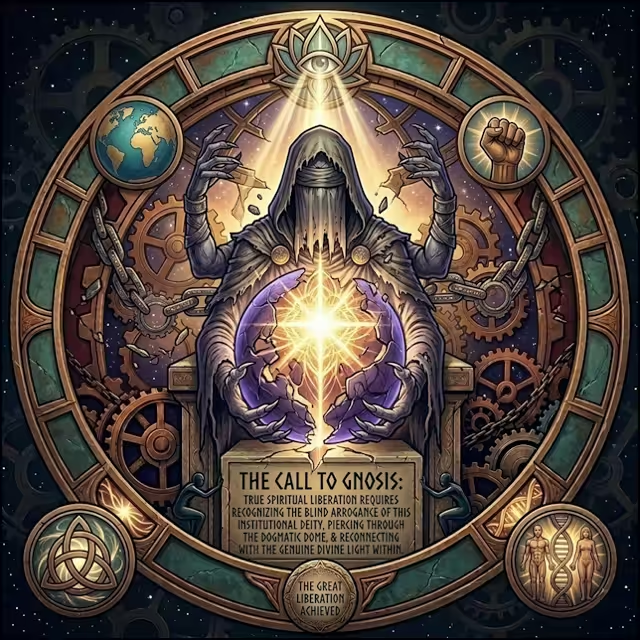
A note on sources. Biblical quotations follow the New Revised Standard Version (NRSV), copyright © 1989 National Council of the Churches of Christ in the USA. Quotations from the Nag Hammadi texts follow the translations collected in The Nag Hammadi Library in English, ed. James M. Robinson (Leiden: Brill; San Francisco: HarperCollins): The Book of Thomas the Contender (NHC II,7) trans. John D. Turner. The spelling “Yaldabaoth” is used throughout for consistency, though translations differ on related names and lineation.
The argument of this series has been deliberately severe, but its severity has had a single object: clarity. The claim has not been that modern right-wing Evangelicalism is merely flawed, hypocritical, or politically compromised. All religious movements are flawed, and hypocrisy alone would be too ordinary to explain the pattern under examination. The claim, rather, has been that a large and influential stream of contemporary Evangelicalism has undergone a deeper inversion. It has exchanged an inward, liberating, and truth-oriented spiritual path for a system organized around blindness, domination, reduction, and counterfeit piety. In the language of the Gnostic parallel, it has come to look less like the community of awakening and more like the cult of Yaldabaoth.
That diagnosis was developed point by point. First, the system became closed to correction, treating ignorance as certainty and mistaking enclosure for faithfulness. Second, it turned toward law, judgment, and domination, seeking external control where inward transformation should have been primary. Third, it relocated spiritual legitimacy into wealth, purity, bodily surveillance, and administrable signs of favor. Fourth, it bent even the figure of Christ into the shape required by the machinery, preaching another Jesus under familiar names and allowing sacred language to become camouflage for a rival spirit. Taken together, these are not random defects. They form a coherent theological profile.
What makes that profile so grave is that it does not merely produce bad behavior. It trains perception. It teaches people what to fear, what to admire, what to call holy, and where to look for God. A community formed this way can become morally earnest and spiritually numb at the same time. It can speak of salvation while dreading freedom, speak of truth while fearing inquiry, speak of holiness while protecting domination, and speak of Christ while recoiling from the shape of his life. This is why the comparison to Yaldabaoth has not been ornamental. It has been diagnostic. The Demiurge is the ruler who mistakes his own bounded order for the whole, and who enforces that mistake through fear, hierarchy, and counterfeit sacredness. Wherever a religious system learns to love those same moves, the analogy begins to carry weight.
Still, a conclusion worth anything must resist two temptations. The first is self-righteousness. It would be easy, having named the distortion, to imagine oneself safely outside all danger of it. But that would only recreate the first problem in a new register. The archontic temptation is not exclusive to Evangelicals, nor to conservatives, nor even to Christians. Every tradition, institution, movement, and ideology is susceptible to counterfeit certainty, to sanctified domination, to the seduction of visible power, and to the seizure of holy names by unholy desires. The point of the diagnosis is not to flatter a rival tribe. It is to expose a spiritual pattern wherever it appears.
The second temptation is despair. Once a system has become this totalizing, it can feel as though nothing remains except denunciation. But denunciation alone cannot be the last word, because the whole burden of the series has been that false rule depends on forgetfulness. To name forgetfulness is already to imply the possibility of remembrance. If blindness were absolute, there would be nothing left to awaken. If captivity were final, there would be no reason to speak at all.
That is why the closing images matter. In The Book of Thomas the Contender, the Savior blesses those who “have prior knowledge of the stumbling blocks” and who “flee alien things,” then exhorts them: “Watch and pray that you not come to be in the flesh, but rather that you come forth from the bondage of the bitterness of this life.”[^1] The exact wording is not identical to the outline’s placeholder paraphrase, but the movement is the same: vigilance, recognition, departure, release. The issue is not hatred of existence. It is awakening from false identification with the order that imprisons perception. Likewise, the New Testament closes the same circle in more compact form: “Sleeper, awake! Rise from the dead, and Christ will shine on you” (Ephesians 5:14, NRSV).[^2] Both traditions, despite their differences, converge on a single imperative: wake up.
To wake up, in the context of this series, means at least four things. It means learning to distinguish God from the institution that claims to speak for God. It means refusing to confuse coercion with holiness, wealth with blessing, shame with repentance, or aggression with courage. It means permitting the figure of Jesus to judge every theology, politics, and spiritual style that invokes his name. And it means recovering the difficult humility required to say that a community can be devout in form while worshiping a distorted image in substance.
This is also why the language of gnosis, used carefully, can still be valuable. Here it does not mean membership in an esoteric elite, nor contempt for ordinary embodied life, nor confidence that one has escaped all error. It means recognition: the moment when the prison stops looking ultimate, when the names stop deceiving, when the machinery is seen as machinery, and when the soul remembers that no bounded system can exhaust the divine. In that limited but serious sense, gnosis names the opposite of archontic religion. It is not possession of a secret. It is release from a lie.
Such release will not look the same for everyone. For some it may mean leaving institutions that have become structurally incapable of repentance. For others it may mean remaining within them as witnesses, critics, and mourners, refusing the counterfeit from inside its walls. For still others it may mean rebuilding a theological imagination that can no longer rely on inherited phrases because those phrases have been captured by another logic. The series has not tried to dictate one path. It has tried to sharpen the question beneath them all: what, in fact, is being worshiped?
That question is more demanding than it first appears. It is possible to reject crude authoritarianism while still quietly desiring the emotional goods it offered: certainty, innocence, hierarchy, protected identity, enemies one can name, and a world in which power seems to reveal righteousness. Waking up therefore cannot be only institutional or intellectual. It must also be affective and spiritual. One must cease to love the prison. One must cease to take comfort in the false god’s promises. One must learn again how to endure ambiguity without surrendering truth, and how to seek holiness without turning it into domination.
The best test of the whole series may therefore be a simple one. After all the comparisons, all the citations, all the arguments, and all the indictments, which image of the divine remains standing? Is it the brittle ruler who demands enclosure, hierarchy, fear, wealth, sacrifice, and perpetual enemies? Or is it the light that liberates, corrects, unmasks, and draws human beings into truth without needing to imprison them there? The answer cannot be assumed from labels alone. It must be discerned by fruits, by structures, by desires, and by the kind of humanity a system produces.
That is where this series has finally been heading. Modern Evangelicalism, in the form criticized here, has not merely drifted into error. It has too often sanctified the very conditions from which the gospel should awaken people. It has taught many to serve the creature rather than the Creator, the prison rather than the light, the machinery rather than the life. To say that is not to deny that grace still works within damaged systems, or that sincere believers can remain caught within structures they did not create. It is to insist that sincerity does not absolve idolatry, and that spiritual seriousness sometimes requires the courage to say that the god being worshiped is not the one being named.
So the final word is not simply condemnation. It is summons. Wake up from the counterfeit certainty. Wake up from the sanctified machinery. Wake up from the fear that calls itself order and the domination that calls itself righteousness. Wake up from the worship of surfaces. Wake up from another Jesus. The point is not to become less spiritual, but more truthful; not to become less Christian, but less captive to the ruler that Christianity itself, at its best, came to unmask. If the series has done its work, then the next task is no longer merely analytical. It is existential. Sleeper, awake.
[^1]: The Book of Thomas the Contender, NHC II,7, trans. John D. Turner, in The Nag Hammadi Library in English, ed. James M. Robinson; Gnostic Society Library, http://www.gnosis.org/naghamm/bookt.html and annotated edition http://www.gnosis.org/naghamm/bookt-jdt.html. The closing section blesses those with prior knowledge of the stumbling blocks and exhorts them to “watch and pray” so as to come forth from “the bondage of the bitterness of this life.”
[^2]: Ephesians 5:14, New Revised Standard Version, oremus Bible Browser, https://bible.oremus.org/?passage=Ephesians%205%3A14&version=nrsv.